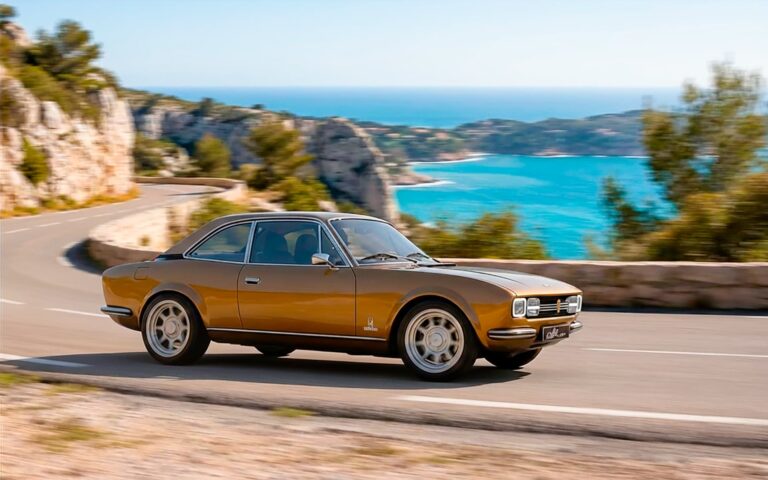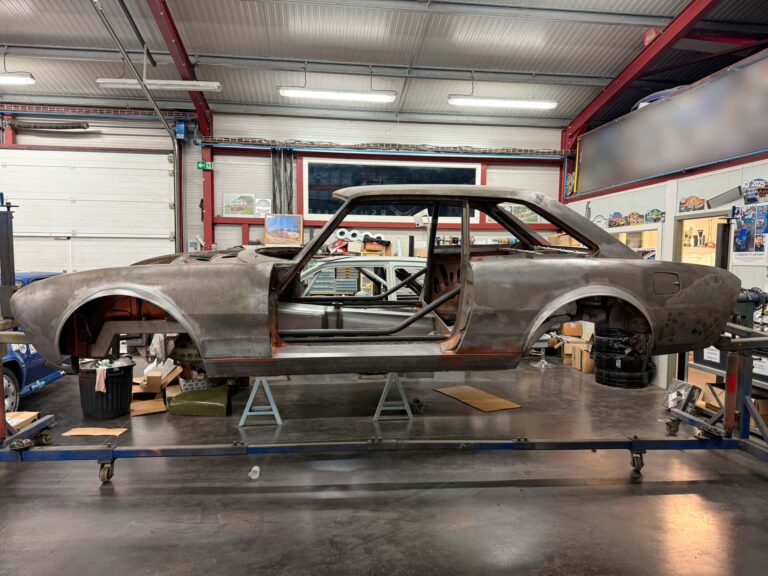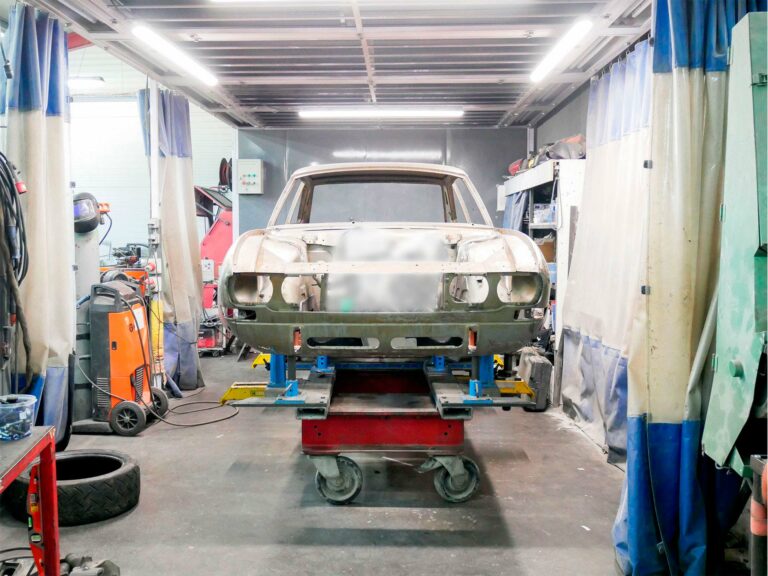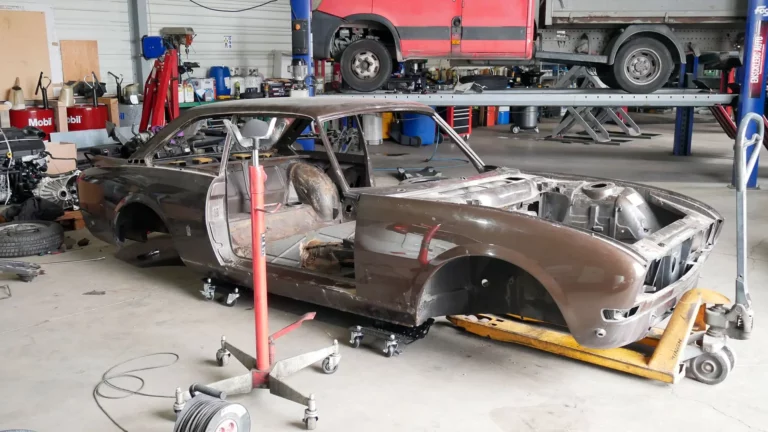
After the first stage of stripping down the 504 — which you can find in our previous article (click here) — another step is necessary to truly start from a clean foundation: stripping the bodywork.
What does stripping consist of? What techniques can be used?
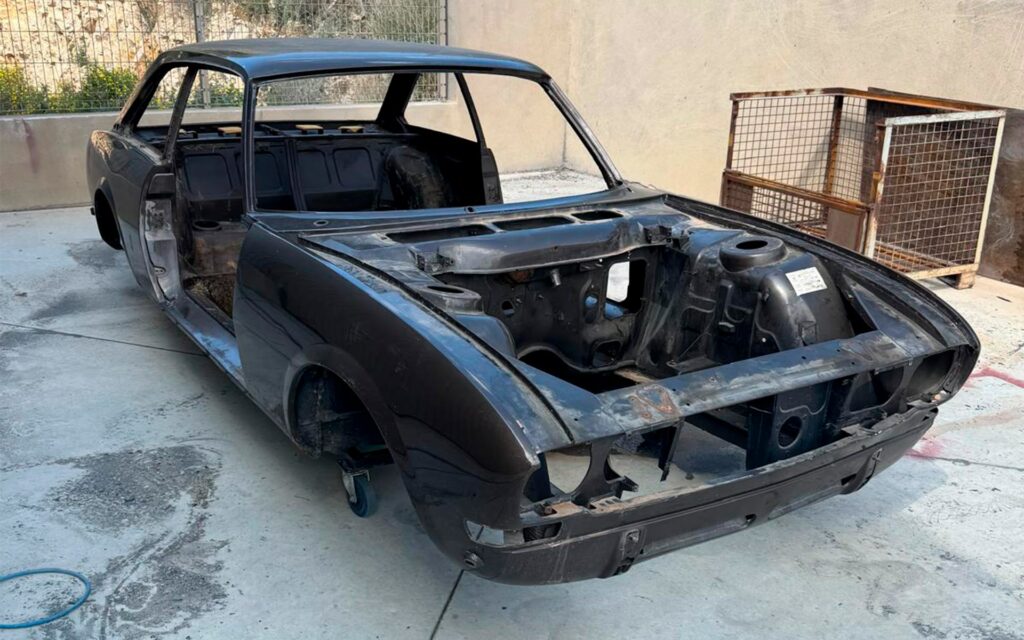
A. Stripping
This is an essential and necessary step in the restoration or preparation of a car, and therefore also in the context of a restomod. Stripping consists of removing old layers of paint, varnish, rust, or impurities present on the bodywork—in our case here—or on mechanical parts. It is necessary to get a clean and healthy base before applying new paint, anti-corrosion treatment, or undertaking a full refurbishment.
The goal is to obtain a clean, smooth, and uniform surface without damaging the metal or underlying materials.
Depending on the type of part (steel, aluminum, plastic, etc.) and the desired result, several stripping methods can be used.
B. The main automotive stripping methods
1. Chemical stripping
The vehicle or the part is covered with a gel or immersed in a chemical bath that dissolves paint and rust.
- Advantages: very effective on multiple paint layers, does not deform sheet metal.
- Disadvantages: requires thorough rinsing, uses environmentally aggressive products, and must be handled with care.
2. Mechanical stripping
Uses physical action to remove material, usually through sanding, brushing, or grinding.
- Advantages: fast, inexpensive, allows visual control of the process.
- Disadvantages: can heat or warp thin sheet metal if not handled properly, may leave micro-scratches.
3. Sandblasting (or bead blasting)
High-pressure projection of abrasive particles (sand, glass beads, corundum, etc.) onto the surface.
- Advantages: very effective on rust and old paint, provides an excellent surface profile for paint adhesion.
- Disadvantages: risk of deforming body panels, requires specific equipment and a suitable blasting booth.
4. Air-gumming (aerogommage)
A softer variant of sandblasting that uses ultra-fine abrasives (bicarbonate, vegetal powders…) at lower pressure.
- Advantages: gentle on fragile surfaces, ideal for classic cars.
- Disadvantages: slower and more expensive, less effective on very thick paint layers.
5. Thermal stripping
Paint is heated with a heat gun to soften it, then manually scraped off.
- Advantages: simple, requires little equipment, eco-friendly (no solvents).
- Disadvantages: risk of overheating or deformation, ineffective on certain modern paints.
6. Electrolytic stripping
A chemical-electrical process mainly used for small metal parts: the part is placed in an electrolytic solution and connected to an electrical current.
- Advantages: excellent for removing rust and oxidation without damaging the metal.
- Disadvantages: slow, limited to removable and small-sized parts.
And one last method — our choice: hydro-stripping.”
For our 504, since the stripping focused on the bodywork and the chassis, we therefore needed a method for ‘large parts’.
And in keeping with our philosophy of circular economy, local sourcing, and environmental responsibility (as much as possible, with the lowest impact), we chose hydro-stripping. And we selected a company located not far from our headquarters, a French company: HYDRO DKP.
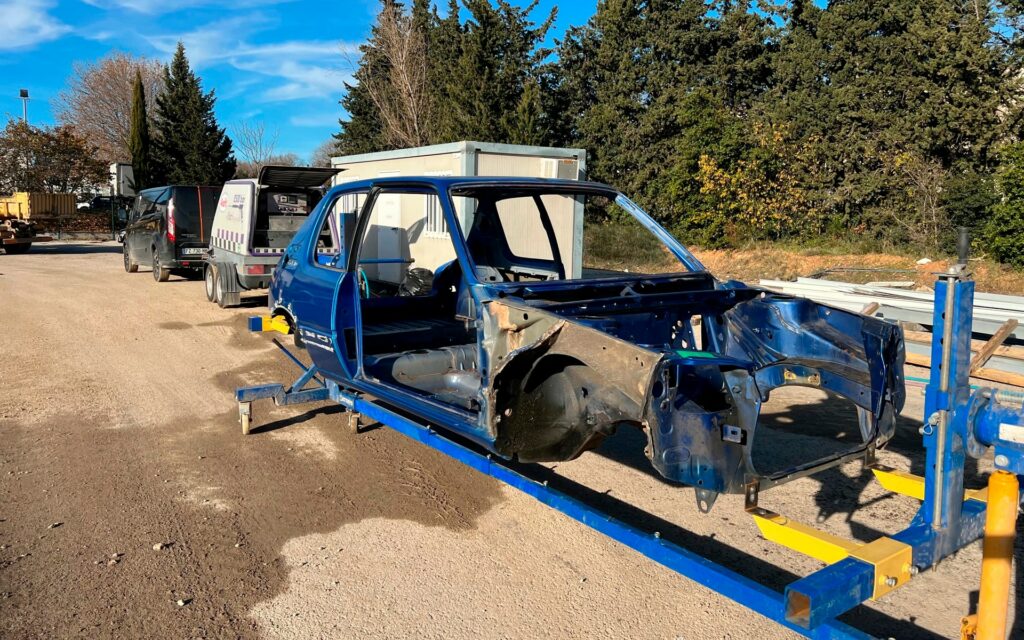
Hydro-stripping (also called water blasting or high-pressure water stripping) is a modern and gentle stripping method, increasingly used in the automotive field, particularly for classic car bodies or delicate parts: the ideal solution for our Project-A 504.
How it works:
It involves projecting high-pressure water, sometimes mixed with a very fine abrasive (such as baking soda or mineral powder), onto the surface to be cleaned.
The combined action of water and abrasive removes layers of paint, varnish, grease, and rust without heating or deforming the metal sheet.
Advantages:
Eco-friendly method, free of chemical solvents.
No metal deformation (no heat involved).
Cleans and strips at the same time (also removes dirt and grease).
Ideal for classic vehicles, aluminum, or delicate surfaces.
Water limits dust and captures particles (cleaner working environment).
Disadvantages:
Requires specific equipment (high-pressure machine suitable for stripping).
Slower than sandblasting on thick layers.
Moisture left on the metal must be quickly dried and protected, as bare metal rusts quickly after treatment.
This method was the most obvious choice for our 504 coupé restomod, both in terms of technical requirements and in staying true to our core philosophy: local sourcing, made in France, and sustainable development with the lowest possible environmental impact.
For these same reasons, we chose the company Hydro-DKP. With more than 10 years of experience in the automotive sector, they were able to treat the 504’s chassis and bodywork using the appropriate equipment and pressure levels.
All of this ensures a perfect foundation before starting the restoration and the necessary improvements to bring our Project-A — our restomod — to life.
Who is Allure Provence Automotive?
Based in Provence, near Aix-en-Provence, Allure Provence Automotive is a company specializing in the restomod of the 504 Coupé—its very first project.
Whether it’s bringing a French icon like the 504 back to life or working on future models, our passion remains the same: ushering classic cars into a new era without ever betraying their soul.