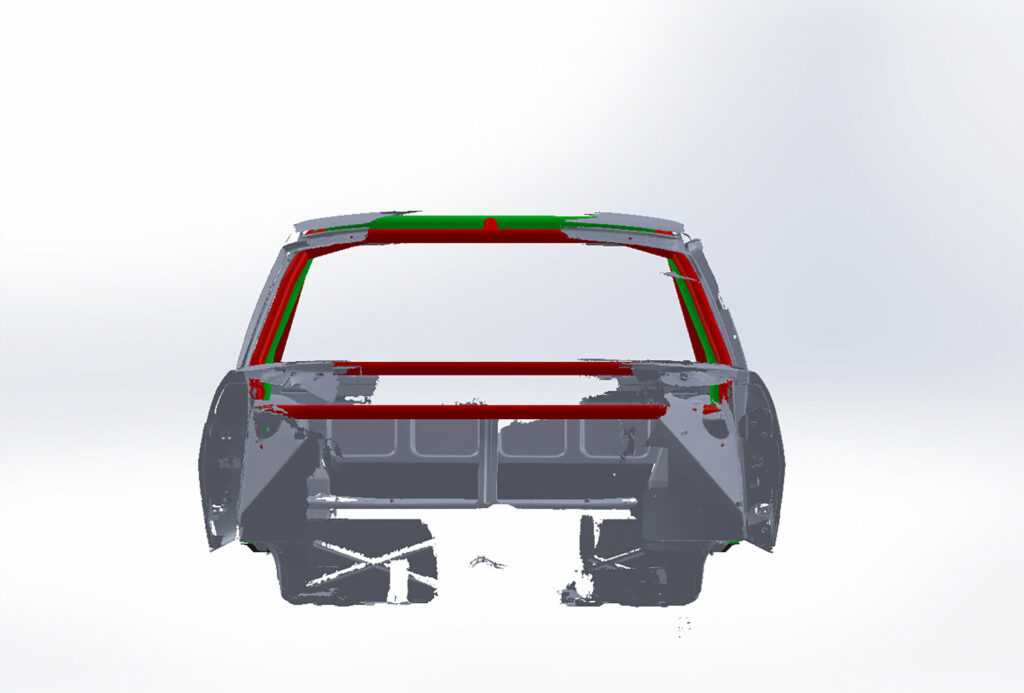
The modern restomod has little in common with the handcrafted builds of the past. Today, the most ambitious projects aim to preserve the soul of a classic automobile while integrating a contemporary level of engineering…
But the moment a vehicle is intended for commercial release — even in only a handful of units per year — one issue becomes paramount: homologation, and therefore, safety testing.
The Core of Small-Series Restomod Homologation
Allure Provence Automotive aims to develop a restomod produced in an ultra-limited series (fewer than 10 vehicles per year). This is now made possible by a major evolution in automotive engineering: the gradual replacement of destructive testing — which would dramatically increase costs — with digital modeling and virtual testing.In this context, 3D technology is no longer just a design tool. It also becomes the very foundation of the vehicle’s technical and regulatory validation: its homologation.
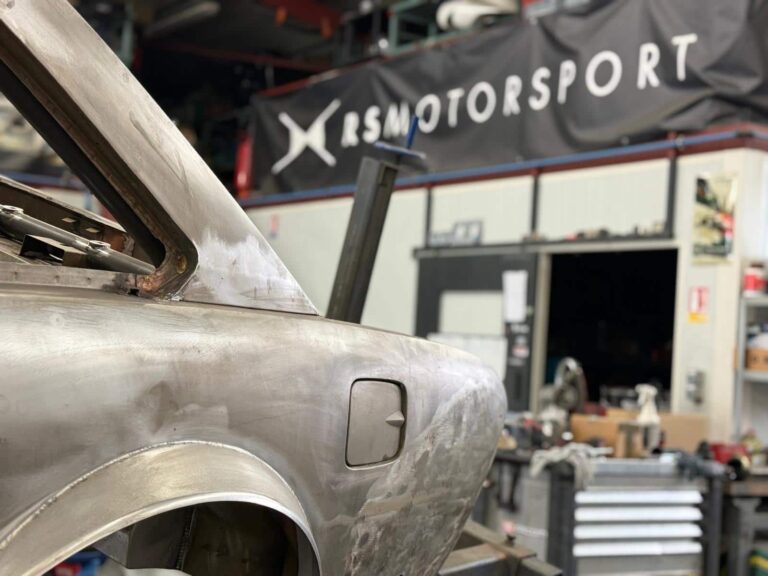
© RSmotorsport
3D Scanning: Capturing Reality to Transform It into a Digital Model
Every serious engineering project — such as the Project-A 504 (click here to discover it) — begins with a fundamental step: the complete digitalization of the vehicle.3D scanning makes it possible to accurately capture the real geometry of both the bodywork and chassis. Unlike a modern vehicle developed from native CAD data (Computer-Aided Design), a classic automobile such as the Peugeot 504 Coupé has no usable digital foundation. The scan therefore becomes the only reliable source for rebuilding its architecture and efficiently preparing future enhancements.This stage generates a dense point cloud describing:
- the body shell geometry,
- real-world manufacturing tolerances,
- existing structural deformations,
- areas of rigidity and structural weakness.
From 3D Scan to Engineering-Ready Model: Surfacing and Intelligent Simplification
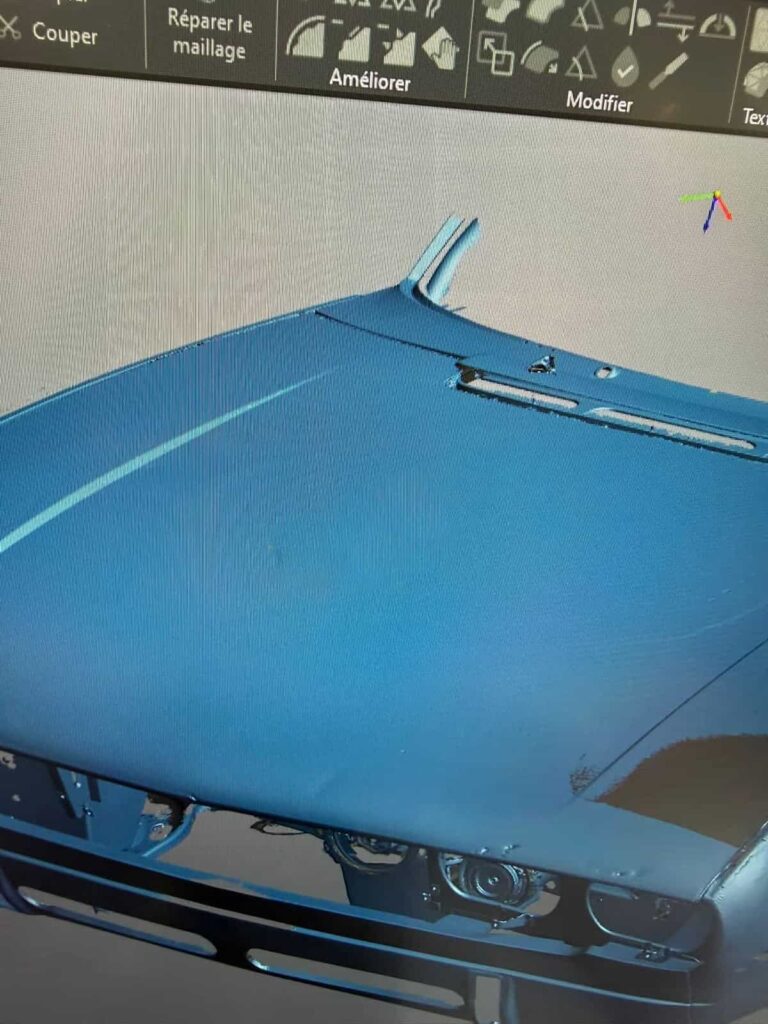
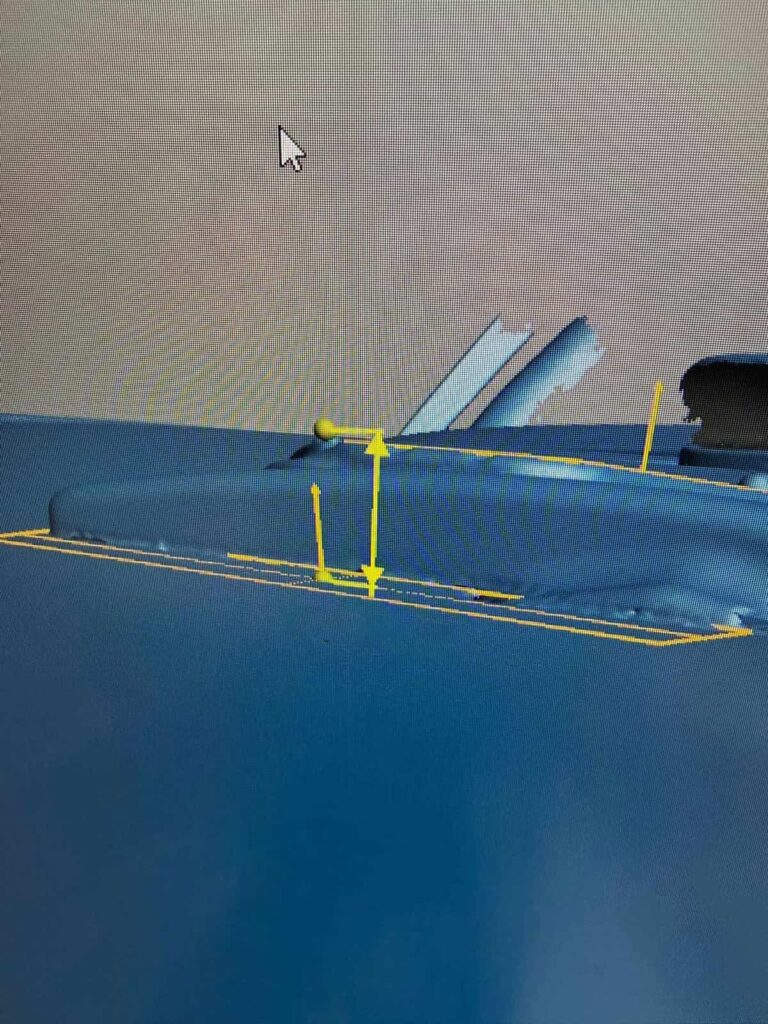
Once the scan has been completed — which is essentially just a point cloud (much like the pixels on a TV screen) — the raw data must be transformed into a coherent digital model. This is the surfacing stage.Contrary to popular belief, the goal is not to reproduce every single detail of the vehicle. An overly detailed model would be unusable for structural simulations.The process therefore consists of:
- rebuilding clean surfaces,
- correcting scan imperfections,
- defining representative material thicknesses,
- simplifying certain non-critical areas.
Virtual Crash Testing: Simulating Without Destroying
Once the 3D model has been built, it is integrated into a structural simulation environment. This is where virtual crash testing comes into play.The vehicle is then digitally discretized into a large number of elements. Each element is assigned physical properties that allow its behaviour under impact to be simulated.The virtual crash test enables the analysis of:
- structural deformation during a collision,
- distribution of mechanical loads,
- load paths within the body structure,
- potential failure zones,
- effectiveness of structural reinforcements.
A Tailored Approach for Modern Restomods

Vehicles modified under a small-series approach often incorporate significant changes:
- new OEM running gear,
- modern energy-absorbing structures,
- chassis reinforcements,
- structural strengthening (A/B/C pillars),
- changes in mass distribution and stiffness.
- do not introduce structural weaknesses,
- improve or maintain overall rigidity,
- guarantee global mechanical consistency.
The Role of Simulation in the Homologation Process
In the context of European small-series homologation, organizations such as TÜV SÜD or TÜV Rheinland are increasingly relying on data derived from digital simulation.Virtual crash testing makes it possible to provide a technical dossier demonstrating:
- structural load management,
- strength of critical zones,
- effectiveness of added reinforcements,
- overall vehicle coherence.
In summary: from scanning to validation
The entire process relies on a coherent digital workflow:
- 3D scanning of the original vehicle
- Surface cleaning, reconstruction, and modification integration
- Creation of a simplified CAD model
- FEM meshing of the structure
- Crash scenario simulation
- Structural results analysis
- Reinforcement adjustments and optimisation
Virtual testing and 3D modelling are not just technical tools. They fundamentally redefine the way a restomod is designed.They make it possible to reconcile two worlds: automotive heritage
and modern engineering.At Allure Provence Automotive, this approach reflects a clear vision: to preserve the essence of an iconic automobile while adapting it to today’s technical requirements, without compromising its character, and while delivering the safety and compliance expected today for its drivers.